The 5 Biggest Audit Risks in Multinational Groups

It's hard to ensure consistency and coordination when you're dealing with cross-border complexities, writes Chartered Accountant James Allsop. As a Manager at Page Kirk, he works alongside multinational groups and has some tips on issues that need careful attention.
Multinational audit risks – article summary
- Cross-border groups often struggle with inconsistent governance and reporting
- Common audit issues include intercompany mismatches and FX differences
- Weak transfer pricing documentation is a major tax risk
- Lack of internal controls across subsidiaries can trigger audit concerns
- Complex funding structures may raise going concern questions
If you're running a UK parent company with subsidiaries in the US, EU or Asia – or you're part of a foreign-owned international group – accounting takes on additional levels of complexity. It's important, of course, that you have professional advice from a firm that is used to working across borders, but it's also good to have an idea of some of the key issues that arise. Here are my top five:
Group Structure and Governance Complexity
Watch out for unclear reporting lines between the parent business and subsidiaries. This might manifest itself in lack of formal oversight or clear minuting, or directors being unaware of local statutory duties. Under the Companies Act of 2006, the responsibilities of UK directors apply at both entity and group level. Sometimes, we see inconsistent practices across different jurisdictions, which can mean different standards of board documentation or levels of control maturity.
Consolidation and Market Reporting
If you're looking for the most common practical problems that arise during audit, they would probably be intercompany balances not agreeing at year-end, delays in eliminating intra-group transactions and foreign exchange differences not being fully reconciled. These are all areas that require careful monitoring over the course of the year. We also encounter inconsistent accounting policies across subsidiaries and poor documentation of consolidation adjustments.
Transfer Pricing and Cross-Border Tax Risk
Watch out for weak documentation on transfer pricing, where intercompany services are not properly priced or management charges are not supported by agreements. And be careful to ensure that profit allocation is properly addressed. It's possible sometimes for IP to be located in one jurisdiction, but managed elsewhere, or key decision-makers to based in a different country to the contracting entity. These issues will be picked up in audits and possibly by tax authorities.
Internal Controls Across Borders
In smaller subsidiaries, there can sometimes be just one or two people working in finance and parent companies tend to rely on trust rather than formal controls. IT and Enterprise Resource Planning systems can frequently be fragmented and, on top of that, it's possible that firms have no manual of formal group financial policies or no matrix for delegation of authority across different entities.
Going Concern and Funding Structures
Watch out here for complex intercompany loans, with no formal agreements and unclear repayment terms. Auditors may well challenge the use of group support letters, questioning whether they are legally enforceable or whether the parent company really has the financial capacity to provide support.
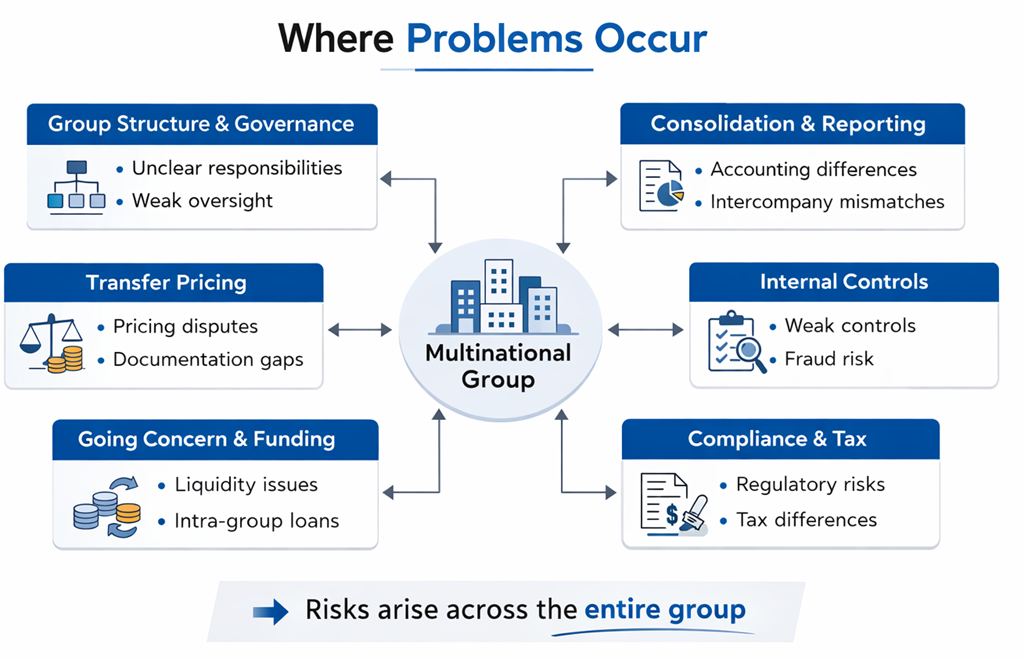
Common themes tend to be companies growing faster than their control frameworks and documentation lagging behind operational reality. And keep an eye out for overreliance on one or two key individuals.
Audit checklist for multinational groups
- Maintain clear group reporting structures
- Reconcile intercompany balances monthly
- Document transfer pricing policies properly
- Implement consistent internal controls across entities
- Formalise intercompany loans and agreements
Managing these risks effectively requires consistent processes, strong oversight and experience working across international group structures. At Page Kirk, we specialise in supporting multinational groups with these exact challenges.
We can help
- UK companies with a non-UK parent which require their UK subsidiary to prepare audited accounts
- UK companies with non-UK subsidiaries which require consolidated accounts preparation and/or audit
- UK resident individuals who have foreign income sources
- UK companies which plan to expand internationally
- UK businesses which have concerns about how Brexit might impact their trade
Click here to view our international services.
Our international capability is strengthened through our membership of the Accelerate network, a community of independent accountancy firms that share specialist knowledge, technical training and best practice. Accelerate is also a business associate of Crowe Global, providing access to trusted firms in more than 130 countries.

We operate a robust quality control framework, with audit files subject to regular internal review and ongoing regulatory monitoring in line with ICAEW standards.
In addition, our work is reviewed through the Accelerate network's quality and technical review processes. Accelerate expects consistently high standards of audit quality and compliance, supported by ongoing technical training and peer review. This layered approach strengthens audit quality, consistency and resilience.
For more advice and guidance on these multinational groups issues, please contact us at enquiries@pagekirk.co.uk or on 0115 955 5500.
FAQ's
What triggers an audit issue in multinational groups?
Inconsistent reporting, weak controls, and poor documentation.
Why is transfer pricing important?
It ensures profits are allocated correctly across jurisdictions.
Do small subsidiaries need formal controls?
Yes, auditors expect consistency across the group.
Fact-checked and up-to-date
Verified
Published: April 2026
The Page Kirk team is committed to providing content that adheres the highest standards for accuracy. We evaluate how the content of each article aligns with current financial procedures and standards. Therefore, the information presented in this article is accurate and up to date at time of publishing.